
- 6Minutes
- 1039Words
- 49Views
Cloud operations are reaching a breaking point
Modern cloud environments are no longer simple or predictable. Enterprises are operating across multi-cloud ecosystems, distributed applications, hybrid cloud infrastructure, Kubernetes workloads, AI-driven systems, APIs, and constantly shifting resource demands.
At this scale, traditional cloud operations seem to struggle. Monitoring dashboards continue generating alerts. Operations teams continue reviewing logs. Incident response processes continue becoming more complex. Yet downtime, alert fatigue, SLA, and operational inefficiencies pressure persists.
Businesses no longer need only visibility into their infrastructure. They need operational intelligence powered by intelligent cloud operations and AI-driven Cloud Managed Services. And this is exactly where self-healing infrastructure is beginning to redefine modern cloud reliability.
What is self-healing infrastructure?
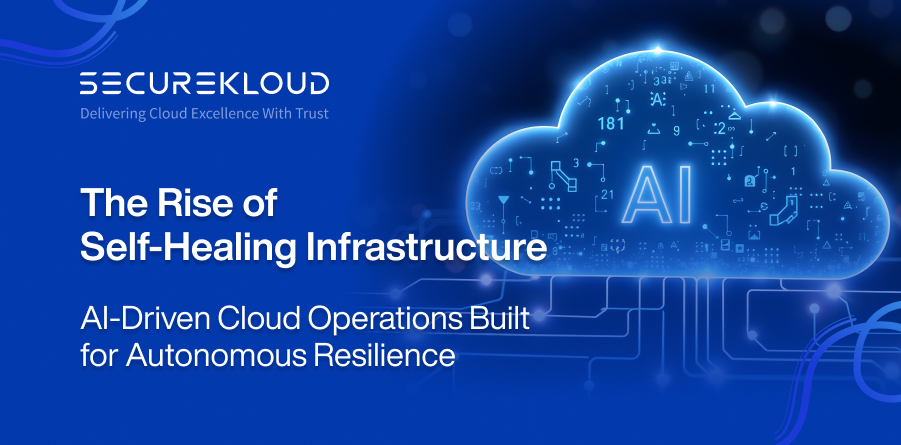
Self-healing infrastructure refers to cloud environments capable of automatically detecting issues, responding intelligently, and restoring operational stability without requiring constant human intervention.
Instead of waiting for operations teams to identify failures manually, self-healing systems continuously observe infrastructure health, analyze anomalies, trigger remediation workflows, and validate recovery automatically.
The objectives are straightforward, i.e. to reduce downtime, improve resilience, and minimize operational overhead. Prevent incidents before they escalate into business disruptions. This shift becomes increasingly important because modern cloud systems evolve faster than manual operational processes realistically can.
Why traditional cloud monitoring is not enough
Enterprise cloud operations have relied heavily on monitoring dashboards, manual remediation processes, and alerting systems. However, cloud complexity has changed dramatically. Distributed architectures now generate enormous volumes of telemetry, logs, traces, alerts, and infrastructure events every second. Operations teams are often forced to correlate multiple signals manually while simultaneously managing uptime expectations and performance SLAs.
The result is operational fatigue. Idle resources keep running even when they are no longer needed, creating operational waste and increasing the need for better cloud cost optimization practices. Workloads become oversized. Small operational inefficiencies quietly compound over time. Mostly, operations teams spend more time reacting to issues rather preventing them. This is why modern AIOps strategies are moving beyond simple monitoring toward autonomous operational systems capable of making infrastructure decisions intelligently.
How a self-healing infrastructure works
At its core, self-healing infrastructure operates through a continuous operational feedback loop:
Observe → Analyze → Predict → Remediate → Validate
The system continuously monitors metrics, logs, traces, infrastructure health signals, and workload behavior in real time. When anomalies appear, AI-driven operational systems analyze patterns, correlate alerts intelligently, and determine whether automated remediation can safely occur.
The platform can then trigger corrective actions such as restarting failed workloads, reallocating resources, scaling environments dynamically, rerouting traffic, or rolling back unstable deployments and enabling AI-driven cloud optimization across distributed environments. Most importantly, the system verifies whether recovery was successful before closing the operational loop.
This significantly reduces Mean Time to Recovery (MTTR) while minimizing operational dependency on manual troubleshooting.
The shift from reactive operations to predictive operations
One of the biggest advantages of self-healing infrastructure is that it shifts cloud operations from reactive incident management toward predictive operational intelligence. Traditional operations usually respond after failures happens. Self-healing systems attempt to identify abnormal patterns before service disruption impacts users. And that distinction matters. Because preventing infrastructure instability before it affects customers is fundamentally different from responding to outages after business operations are already impacted. AI-driven operational platforms can continuously analyze workload behavior, resource consumption patterns, infrastructure anomalies, traffic spikes, and operational drift in real time.
This allows organizations to proactively optimize cloud environments instead of constantly firefighting operational incidents.
Why self-healing infrastructure matters for enterprises
As enterprise cloud ecosystems continue expanding, operational scalability becomes a serious challenge. Infrastructure grows faster than operations teams. Applications become more distributed. Customer expectations around uptime continue increasing. Manual operational workflows can become difficult to maintain as cloud infrastructure scales.
Self-healing infrastructure addresses these issues by automating routine operational tasks while strengthening overall cloud disaster recovery strategy and operational resilience. The impact is visible across these areas such as:
- Reduced downtime and faster recovery
- Improved SLA performance
- Lower operational overhead
- Reduced alert fatigue for operations teams
- Better infrastructure scalability
- Higher operational consistency
- Improved cloud governance and visibility
And perhaps most importantly, better customer experience. Because the best operational issue is often the one users never experience at all.
AIOps and the future of autonomous cloud operations
Self-healing infrastructure is closely tied to the broader evolution of AIOps. Modern AIOps platforms combine AI, automation, observability, operational analytics, and remediation workflows into unified operational ecosystems through enterprise cloud automation platforms like CaDP. This is no longer just about automation scripts. It is about creating operationally intelligent systems capable of learning, adapting, predicting, and responding continuously.
SecureKloud’s iCMS are being designed around this direction by combining intelligent cloud operations, predictive monitoring, automation workflows, operational visibility, and AI-driven remediation capabilities into a centralized cloud operations framework. As cloud environments continue becoming more dynamic, autonomous operations will likely become less of a competitive advantage and more of an operational necessity.
Wrap Up
Self-healing infrastructure refers to cloud systems capable of automatically detecting operational issues, triggering remediation actions, and restoring stability without requiring manual intervention.
Self-healing systems reduce downtime by identifying anomalies early, automating corrective actions, and maintaining operational continuity across cloud environments.
AI helps analyze operational patterns, correlate alerts, detect anomalies, predict failures, and trigger intelligent remediation workflows automatically.
Traditional monitoring primarily alerts operations teams after issues occur. Self-healing infrastructure goes further by automating detection, decision-making, remediation, and recovery processes.
Modern enterprise cloud environments are highly complex and dynamic. Self-healing infrastructure helps organizations reduce MTTR, improve SLA performance, minimize operational overhead, and scale cloud operations more efficiently.