
- 5Minutes
- 823Words
- 78Views
What AI-Driven Cloud Optimization Means
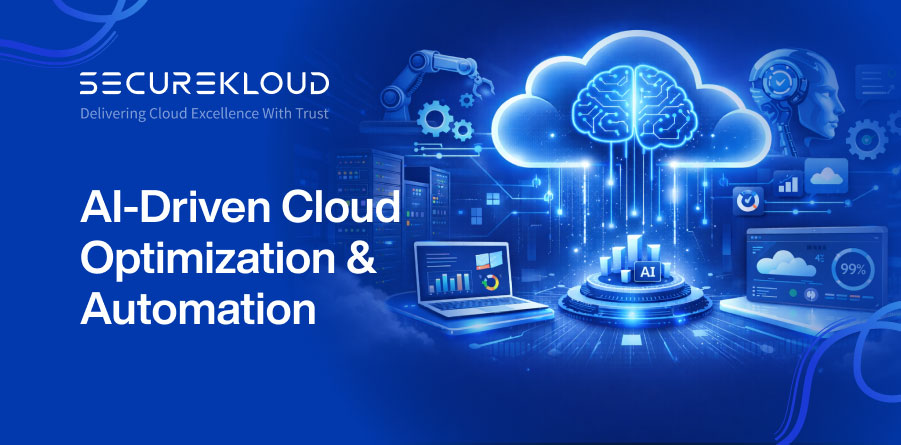
Cloud optimization is the process of improving how cloud resources are utilized to reduce waste, enhance performance, and maintain control. When powered by AI, this becomes continuous and predictive. AI-driven cloud optimization enables:- Intelligent resource right-sizing
- Real-time cost and usage analysis
- Predictive anomaly detection
- Automated workload optimization
Why Enterprises Need Cloud Optimization Now
Cloud environments have become:- Highly dynamic and distributed
- Cost-intensive with unpredictable spend
- Complex to manage across teams and platforms
- Rising and uncontrolled cloud costs
- Idle or overprovisioned resources
- Performance bottlenecks
- Limited governance and visibility
Where Automation Changes Cloud Operations
Automation is what enables cloud optimization to scale. With automation, organizations can:- Enforce policies across environments
- Automate scaling based on demand
- Reduce manual intervention in operations
- Improve consistency in cloud management
Key Use Cases of Cloud Optimization & Automation
1. Intelligent Rightsizing: Automatically adjusts compute and storage based on actual usage, reducing waste. 2. Cost Anomaly Detection: Identifies unusual spending patterns early, enabling quick corrective action. 3. Autoscaling and Smart Provisioning: Ensures infrastructure scales dynamically with workload demand. 4. Cloud Cost Governance: Applies policies and controls to manage budgets and prevent cost overruns.AI-driven Cloud Optimization Business Outcomes
AI-driven cloud optimization delivers measurable results:- Lower cloud costs through continuous optimization
- Improved application performance
- Faster incident response
- Better visibility into usage and spend
- Strong alignment with FinOps practices
How SecureKloud Approaches Cloud Optimization
SecureKloud takes a continuous and enterprise-driven approach to cloud optimization and automation. Through its cloud managed services, organizations can:- Implement structured cloud cost optimization using FinOps principles
- Automate infrastructure and workload management
- Gain real-time visibility into cloud performance
- Improve governance across multi-cloud environments
Wrap Up
AI-driven cloud optimization uses artificial intelligence and machine learning to continuously analyze cloud usage, performance, and costs, and automatically improve how resources are allocated. It helps enterprises reduce waste, improve efficiency, and maintain better control over cloud environments.
Cloud optimization reduces costs by identifying unused or underutilized resources, right-sizing infrastructure, and preventing unnecessary spend. AI-driven cloud cost optimization also detects anomalies and enforces policies to keep cloud usage aligned with budgets.
Automation enables cloud optimization to scale. It allows organizations to automatically manage resource allocation, enforce policies, and respond to changes in demand without manual intervention. Combined with AI, it creates intelligent and self-optimizing cloud operations.
AI-driven cloud optimization helps organizations:
- Reduce cloud costs
- Improve application performance
- Increase operational efficiency
- Gain real-time visibility into usage and spend
- Strengthen governance and compliance
Cloud cost optimization focuses on controlling and reducing cloud spend while maintaining performance. It is important because cloud costs can grow rapidly without visibility, leading to inefficiencies and budget overruns.
AI improves cloud operations by enabling predictive monitoring, anomaly detection, and automated responses. This allows systems to identify issues early, optimize performance, and reduce downtime without relying on manual intervention.
Cloud management focuses on maintaining and operating cloud environments, while cloud optimization focuses on improving efficiency, performance, and cost. Optimization is a continuous process that enhances how cloud resources are used.
Common use cases include:
- Intelligent rightsizing of resources
- Cost anomaly detection
- Autoscaling and workload optimization
- Cloud cost governance and policy enforcement
AI-driven cloud optimization supports FinOps by providing real-time cost visibility, automated cost control, and data-driven insights. It helps organizations align cloud spending with business outcomes and improve financial accountability.
Enterprises can start by assessing current cloud usage, identifying cost inefficiencies, and implementing automation for routine tasks. Partnering with providers such as SecureKloud Technologies offering cloud managed services can help accelerate adoption and ensure continuous optimization.