
- 6Minutes
- 1331Words
- 64Views
Cloud adoption often starts with speed. Teams want faster deployments. Business units want flexibility. Leaders want lower infrastructure costs.
Cloud makes all this possible. It gives enterprises the power to scale operations fast. Launch faster and avoid heavy upfront infrastructure costs.
As cloud adoption grows, new challenges emerge. Who is controlling cloud usage? Who is tracking cloud costs? Who is monitoring security risks? Who is ensuring compliance is followed?
This is where cloud governance becomes critical. Leading enterprises now rely on cloud managed services to bring structure, visibility, and control to cloud environments.
Think of cloud like a busy airport. Planes can take off faster, land faster, and move more passengers. But without air traffic control, speed can quickly turn into chaos. Cloud governance acts like that control tower. It gives every workload, user, cost, and security policy a clear direction.
What is a Cloud Governance Framework?
Cloud governance defines how enterprises use cloud resources. It includes policies, processes, and controls. It ensures structured and controlled cloud usage. It helps organizations manage:
- cloud costs
- access controls
- security policies
- compliance requirements
- data protection
- cloud operations
- resource usage
- risk management
Without it, cloud environments can become difficult to manage. Teams may create resources without approval. Costs may rise without visibility. Security gaps may go unnoticed. Compliance teams may struggle to prove control.
A strong cloud governance framework prevents this.
Why Cloud Governance Matters After Cloud Adoption
Cloud adoption does not end with migration. Often, the real challenge begins after migration. Once workloads move to the cloud, especially in hybrid cloud architecture environments, enterprises need to manage daily cloud operations. Control user access. Track and allocate costs. Enforce security policies and monitor performance.
Without governance, cloud environments grow without control. A sudden increase in cloud costs. Unused or idle resources go unnoticed. Shadow IT emerges across departments. Weak access controls increase risk. Security practices become inconsistent. Visibility across cloud assets gets limited. Tracking usage and performance becomes difficult. Compliance gaps start to appear and accountability across teams becomes unclear.
This is why cloud governance is not optional. It is a must for long-term cloud success.
The Four Pillars of a Cloud Governance Framework
A practical cloud governance framework should cover four key areas.
1. Cloud Financial Management
Cloud gives enterprises flexibility, but it can also create cost surprises.
Teams may spin up resources for testing and forget to shut them down. Multiple departments may use cloud services without a shared budget view. Storage, backup, data transfer, and compute costs can grow quietly.
Cloud financial management helps enterprises control this. Cloud financial management helps enterprises control this. For practical approaches, explore cloud cost optimization strategies.
It includes:
- cloud budgets
- cost allocation by teams or projects
- tagging policies
- usage monitoring
- idle resource cleanup
- FinOps practices
- cost optimization reports
This ensures cloud spending supports business value, not waste.
2. Cloud Operations Management
Cloud operations must be consistent, visible, and well-managed.
A governance model defines how cloud resources are provisioned, monitored, maintained, and retired. It defines how changes are managed. It sets the process for incident response. It establishes backup strategies and ensures cloud disaster recovery services are in place to maintain service availability.
Good cloud operations governance helps enterprises avoid fragmented cloud usage. It ensures every workload has:
- defined ownership
- performance monitoring
- uptime expectations
- access rules
- backup policies
- incident response processes
- operational accountability
This improves reliability and reduces operational risk.
3. Cloud Data Security
Data security is one of the most important parts of cloud governance. Enterprises must know where their data resides, who accesses it, how secure it is, and how long it should be retained.
Cloud data security includes:
- data classification
- encryption at rest and in transit
- access control
- data lifecycle policies
- backup and recovery
- data privacy controls
- monitoring of sensitive data usage
Strong cloud data protection helps reduce the risk of breaches, and compliance failures.
4. Cloud Security and Compliance
Cloud security governance defines how enterprises reduce risk across cloud environments. This is often supported by enterprise cybersecurity offerings that strengthen security controls and compliance.
It encompasses identity management, network security, workload protection, application security, cloud security controls, and continuous compliance monitoring. A mature cloud security governance framework helps enterprises:
- detect misconfigurations
- reduce cloud security risks
- enforce policies
- monitor access
- protect workloads
- respond to threats faster
- meet industry compliance standards
Cloud security should not depend only on manual reviews. It must be built into the cloud operating model.
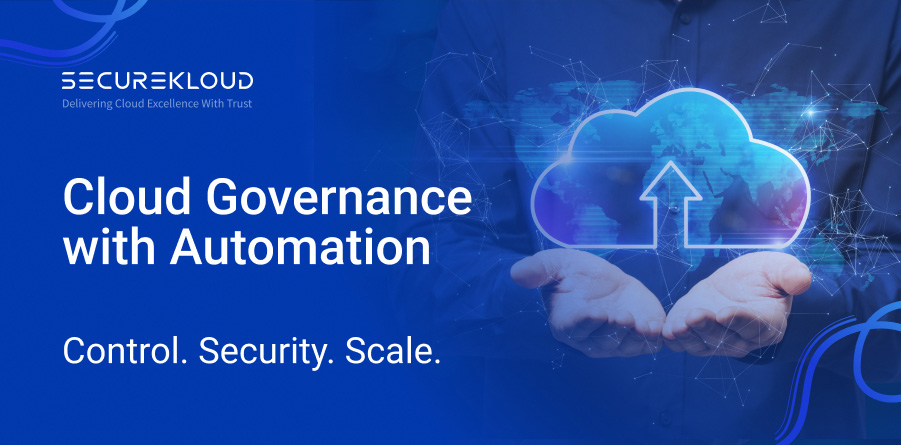
Cloud Governance Using Automation
Cloud governance should not slow teams down. It should help them move faster with control.
Automation makes this possible. Learn how automation drives efficiency in AI-driven cloud optimization.
With automation, enterprises can enforce cloud security policies consistently across environments. Detect policy violations in real time. Trigger instant alerts for faster response. Enable timely and automated remediation. Streamline resource provisioning through automation. Ensure standardized configurations across workloads. Reduce dependency on repetitive manual reviews. Reduce human error in cloud operations. Improve compliance reporting with audit-ready insights.
Automation helps enterprises prevent issues before something goes wrong. This is the shift from reactive cloud management to proactive cloud governance.
How to Implement a Cloud Governance Framework
Implementing a cloud governance framework starts with defining clear policies, assigning workload ownership, and standardizing resource usage. Enterprises should then automate policy enforcement, monitor cloud environments continuously, and align governance rules with business goals. This helps cloud teams move faster while maintaining cost control, security, and compliance.
How SecureKloud Approaches Cloud Optimization
Learn more about choosing the right managed cloud services provider.
SecureKloud’s Cloud Managed Services help organizations manage cloud operations across cost, security, compliance, performance, and availability.
- cloud advisory
- cloud migration
- cloud deployment
- cloud monitoring
- FinOps and cost optimization
- cloud security management
- backup and disaster recovery
- 24×7 managed services and NOC support
SecureKloud helps enterprises move from scattered cloud operations to a structured governance model. Learn how to choose the right managed cloud services provider for your business.
This gives leaders better control, visibility, and confidence in their cloud investments.
Wrap Up
Just like an airport needs air traffic control to manage safe movement, enterprises need cloud governance to manage secure and scalable cloud growth.
With SecureKloud Cloud Managed Services, businesses can build cloud environments that are not only fast and flexible, but also secure, compliant, and cost-efficient.
Ready to strengthen your cloud governance strategy?
Cloud governance is a set of policies, processes, and controls that define how an organization uses cloud resources. It helps manage costs, improve cloud security, and ensure compliance across cloud environments.
After cloud adoption, enterprises face rising costs, security risks, limited visibility, and compliance gaps. Cloud governance helps control usage, enforce policies, and improve accountability.
A cloud governance framework includes cloud financial management, cloud operations management, cloud data security, and cloud security and compliance.
Automation helps enforce policies, detect violations, trigger alerts, and enable faster remediation. It reduces manual effort and improves compliance reporting.
Cloud managed services support governance through continuous monitoring, cost optimization, security management, compliance support, backup, disaster recovery, and 24×7 operations.