
- 5Minutes
- 1006Words
- 29Views
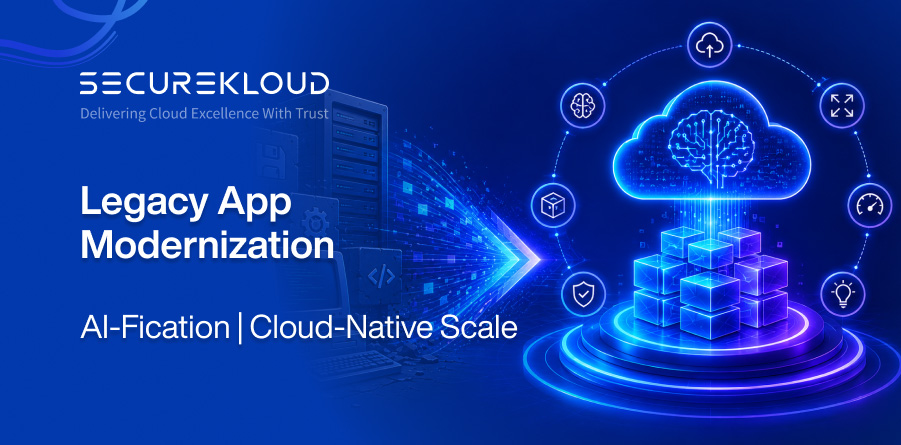
Most enterprises don’t have a legacy application problem. They have a legacy thinking problem, the assumption that modernization means lifting an old system and setting it down somewhere newer. A straight migration doesn’t fix what’s actually broken: rigid architecture, disconnected data, and zero room for AI. Real modernization means rebuilding for intelligence, not just relocating for convenience.
What does legacy application modernization involve?
Legacy application modernization is the process of transforming outdated systems into scalable, cloud-ready applications built on modern architecture. It typically follows one of four paths, chosen based on urgency, budget, and long-term goals:
(a) Rehost — move the application to the cloud with minimal changes, prioritizing speed
(b) Refactor — restructure the code for better scalability without changing core functionality
(c) Replatform — shift to a new platform while preserving the application’s core architecture
(d) Rebuild — redesign the application from the ground up for full transformation
The right path depends on a proper discovery and assessment of the existing application landscape, not a one-size-fits-all migration plan.
Why AI-fication changes the modernization conversation
Modernizing an application without embedding AI is a missed opportunity. AI-fication means weaving machine learning directly into re-architected systems, so the application doesn’t just run faster, it runs smarter.
This looks like:
(a) Predictive analytics and forecasting built into core workflows
(b) NLP chatbots and smart interfaces replacing static forms and dashboards
(c) ML model integration via APIs, without needing to rebuild everything from scratch
(d) Intelligent dashboards and BI that surface insights instead of raw data
(e) AI-enhanced workflow automation, cutting manual intervention at every step
(f) Recommendation engines tailored to user behavior
(g) AI-powered threat detection, so security gets smarter as the system does
What makes an architecture cloud-native and why does it matter?
Cloud-native architecture is built on microservices, containers, serverless computing, and API-first design, so applications scale on demand instead of hitting a hardware ceiling. Whether the target environment is AWS, Azure, or GCP, the goal is the same: elastic, containerized infrastructure that responds to real business load rather than static provisioning.
This is also where technical debt gets addressed directly. Legacy monoliths that once took weeks to update can move to modular, Docker-and-Kubernetes-based design, deployed through Infrastructure as Code (IaC) instead of manual configuration.
How legacy data becomes a business asset again
Legacy systems often sit on years of valuable data that nobody can easily use. Modernization paired with AI unlocks that data for real decision-making, better customer engagement, and sharper operational efficiency, instead of leaving it buried in formats only the old system understands.
Can you modernize without disrupting the business?
Yes. Business continuity during modernization comes down to how the rollout is managed, not whether disruption is avoidable. Progressive deployment models, like blue-green or canary releases, combined with CI/CD pipelines, container orchestration, and strong fallback mechanisms, let legacy systems transform in phases with minimal downtime.
This same CI/CD foundation also modernizes the software development lifecycle (SDLC) itself, so every future deployment of an AI-enabled application ships faster and safer.
Where does security fit into modernization?
Security isn’t a phase that comes after modernization, it’s built in from the start. That means DevSecOps practices, role-based access controls, and encryption standards applied throughout the rebuild, aligned with compliance frameworks like GDPR, HIPAA, and India’s DPDPA. Treated this way, modernization becomes an opportunity to fix legacy security gaps, not just carry them forward into a newer environment.
How do you measure if modernization actually worked?
The real signals are operational, not just aesthetic:
(a) reduced deployment time
(b) cloud cost efficiency
(c) application uptime
(d) technical debt reduction
(e) faster time-to-market for new features
(f) improved customer experience and developer productivity
If these numbers aren’t moving post-modernization, the rebuild solved the wrong problem.
What comes after go-live?
Modernization doesn’t end at deployment. Ongoing monitoring, performance tuning, DevSecOps enablement, cloud cost governance, and scalability audits ensure the application keeps evolving with the business, instead of becoming the next legacy system in five years.
Wrap Up
It’s the process of transforming outdated, legacy IT systems into agile, scalable, cloud-ready applications, so enterprises can align their IT with business goals and keep pace with digital-first competition.
No. Cloud migration moves an application to the cloud, often with minimal changes. Modernization goes further, restructuring the application’s architecture, data handling, and often embedding AI, so it’s built to scale, not just relocated.
There’s no single best option. It depends on the application’s current state, business urgency, and long-term cloud strategy. A proper discovery and assessment should guide the choice, not a default preference.
Timelines vary widely based on scope, from a few months for a rehost to over a year for a full rebuild. Phased rollouts using blue-green or canary deployment models help deliver value incrementally rather than waiting for one big launch.
It can, if security is treated as an afterthought. Done correctly, modernization is an opportunity to embed DevSecOps practices, encryption, and compliance frameworks like GDPR, HIPAA, and DPDPA from day one, closing gaps the legacy system carried for years.
In many cases, yes. ML models can be integrated via APIs into an already-modernized architecture, enabling capabilities like predictive analytics, intelligent dashboards, and automation without starting from zero.
Key indicators include reduced deployment time, cloud cost efficiency, uptime, technical debt reduction, and faster time-to-market, alongside softer metrics like developer productivity and customer experience improvements.