
- 5Minutes
- 1062Words
- 46Views
As organizations adopt hybrid cloud, multi-cloud, and cloud-native architectures, IT teams are expected to manage growing workloads, maintain security, optimize costs, ensure compliance, and deliver uninterrupted business operations.
Traditional cloud management approaches often struggle to keep pace with this complexity. This is where Artificial Intelligence (AI) is transforming cloud operations management.
And this is exactly where self-healing infrastructure is beginning to redefine modern cloud reliability.
In this blog, we explore the core advantages of integrating AI into cloud operations management and how enterprises can use AI to build more resilient, efficient, and cost-effective cloud environments.
Why Cloud Operations Are Becoming More Challenging
Cloud adoption has delivered agility, scalability, and innovation. Organizations today must manage:
- Dynamic workloads
- Multiple cloud environments
- Increasing security threats
- Regulatory compliance requirements
- Rising cloud costs
- Business continuity expectations
Managing these variables manually often leads to inefficiencies, delayed responses, and higher operational risk. AI helps organizations move from reactive cloud management to proactive cloud operations.
What Is AI-Driven Cloud Operations Management?
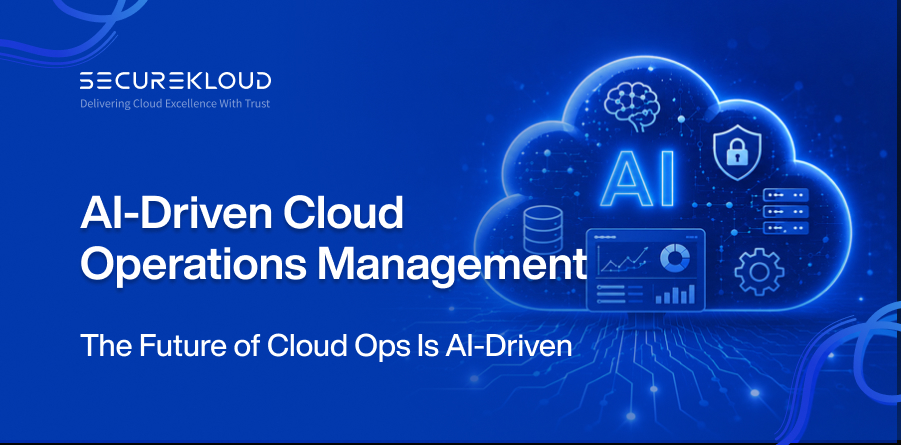
AI-driven cloud operations management combines Artificial Intelligence, Machine Learning (ML), predictive analytics, and automation to monitor, manage, and optimize cloud environments.
Instead of relying solely on manual intervention, AI continuously analyzes cloud infrastructure, applications, workloads, and operational data to identify patterns, predict issues, and automate responses.
This approach is often referred to as AIOps (Artificial Intelligence for IT Operations).
Core Advantages of Integrating AI into Cloud Operations Management
Automated Infrastructure Monitoring
Monitoring cloud environments generates massive volumes of operational data. AI helps continuously analyze logs, events, metrics, and system behavior to identify anomalies in real time. This enables operations teams to detect issues earlier, reduce alert fatigue, improve incident response times, and minimize operational disruptions.
Predictive Issue Detection
One of the biggest advantages of AI is its ability to predict problems before they impact business operations. By analyzing historical and real-time data, AI can identify patterns that often precede failures. This allows organizations to prevent outages, reduce downtime, improve service availability, strengthen operational resilience.
Intelligent Cloud Cost Optimization
Cloud costs remain a major concern for enterprises. Organizations looking to reduce cloud waste and improve utilization should also explore cloud cost optimization strategies for smarter operations. AI helps identify underutilized resources, idle workloads, oversized infrastructure, cost anomalies, and optimization opportunities. Combined with FinOps practices, AI enables organizations to make smarter decisions about resource allocation and cloud spending. The result is improved utilization and better cost control without compromising performance.
Enhanced Security and Threat Detection
Cloud environments face a growing number of security threats. AI continuously monitors user activity, workloads, network traffic, and access patterns to identify unusual behavior. Benefits include faster threat detection, improved incident response, reduced security risk, and better visibility across environments. AI can also automate security actions based on predefined policies and risk thresholds.
Improved Compliance and Governance
Maintaining compliance across cloud environments can be challenging. AI helps automate governance by continuously validating configurations, policies, and operational controls. This becomes increasingly important as organizations strengthen cloud governance frameworks after cloud adoption. Organizations can benefit from automated policy monitoring, faster compliance reporting, reduced manual audits, improved governance, and consistency. This becomes particularly valuable for organizations operating across multiple business units, geographies, or cloud platforms.
Smarter Disaster Recovery and Business Continuity
Business continuity depends on the ability to recover fast from disruptions. AI supports disaster recovery strategies by monitoring recovery readiness, identifying potential risks, automating recovery workflows, and optimizing failover processes. This helps organizations strengthen operational resilience while reducing recovery times.
Greater Operational Efficiency
Many cloud operations tasks remain repetitive and resource-intensive. AI automates routine activities such as resource provisioning, incident correlation, capacity planning, performance optimization, and workflow automation. Many organizations are already leveraging self-healing cloud infrastructure capabilities to reduce manual intervention.
How SecureKloud Supports AI-Driven Cloud Operations
At SecureKloud Technologies, our Cloud Managed Services help organizations modernize cloud operations through a combination of AI-driven automation, cloud management expertise, and operational best practices.
Our capabilities include:
- AI-Driven Cloud Infrastructure Management
- Migration and Customer Adoption
- 24×7 Operations Support
- Disaster Recovery
- FinOps and Cost Optimization
- Secure DevOps and Compliance
Through our Cloud Automation and Data Platform (CaDP), enterprises can accelerate cloud adoption while improving visibility, governance, operational efficiency, and business resilience.
Wrap Up
AI-driven cloud operations management uses Artificial Intelligence, Machine Learning, and automation to monitor, optimize, secure, and manage cloud environments with minimal manual intervention.
Key benefits include automated monitoring, predictive issue detection, cost optimization, enhanced security, improved compliance, disaster recovery automation, and greater operational efficiency.
AI identifies underutilized resources, cost anomalies, and optimization opportunities, helping organizations improve cloud utilization and reduce unnecessary spending.
AIOps stands for Artificial Intelligence for IT Operations. It combines AI, analytics, and automation to improve IT and cloud operations management.
SecureKloud provides AI-driven cloud infrastructure management, FinOps, disaster recovery, 24×7 operations support, secure DevOps, compliance services, and cloud modernization through its CaDP platform.