
- 11Minutes
- 2165Words
- 10Views
Here is a scenario that plays out across cloud environments. An engineer spins up a new database cluster on a Friday afternoon because a release needs it. Three weeks later, a finance analyst spots a spike in the cloud bill with little context attached. By the time anyone connects those two dots, the decision is old history, and nobody quite remembers why it happened.
Multiply that across hundreds of cloud decisions, and you get an organization that technically has cloud cost data but may not have a clear understanding of what is driving it.
That gap between the people consuming cloud resources and the people tracking the spend is exactly what FinOps exists to close. The FinOps maturity model provides a way for organizations to understand where individual cloud financial management capabilities stand today and how they can mature over time.
In this blog, we will look at the Crawl, Walk, and Run stages of FinOps maturity, what changes as organizations progress, where that progress can get stuck, and how enterprises can assess where their FinOps capabilities stand today.
FinOps maturity is not one-size-fits-all
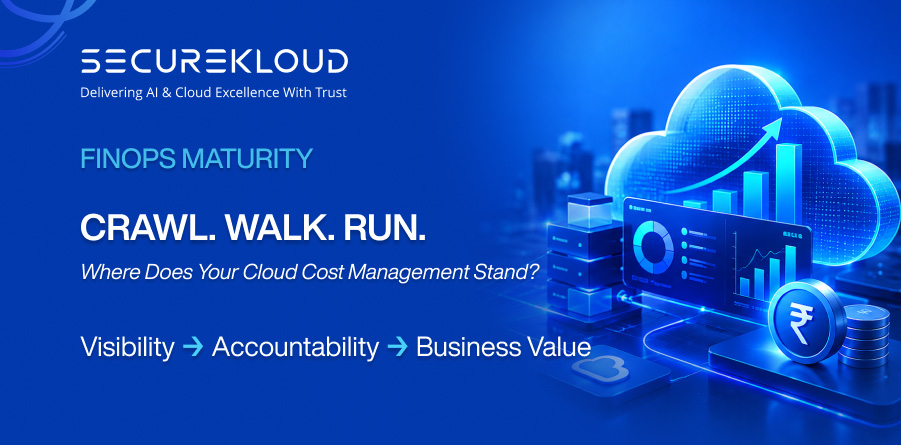
Unlike a maturity framework that assigns one overall score to an organization, the FinOps maturity model evaluates individual capabilities across three stages:
- Crawl
- Walk
- Run
An organization could have sophisticated, automated anomaly detection running in production while it’s forecasting still involves someone reviewing last quarter’s invoice in Excel. That is not a contradiction. It simply means different FinOps capabilities have reached different levels of maturity.
The objective, therefore, is not to push every capability toward Run as quickly as possible. It is to understand where each capability stands and determine the level of maturity the business actually needs.
Crawl, Walk, Run: what actually changes at each stage
Crawl
Crawl is where the FinOps journey begins. An organization may be able to see billing at an account or service level, but not necessarily at the workload that caused it. Some resources may carry the right tags while others do not. Forecasting may still depend largely on previous cloud bills, while cost reviews tend to be periodic and reactive. At this stage, the immediate priority is visibility. Organizations need to understand what they are spending, where that spend originates, and who or what owns it.
Walk
Walk is where cost starts getting attached to a real owner. A business unit may see a bill that reflects what it consumed, which is showback, or the organization may assign those costs to the responsible team’s budget through chargeback. Reporting also becomes more structured and automated. Forecasts can begin accounting for usage trends instead of simply repeating the previous month’s number. When unusual spending appears, there is clearer ownership for investigating it.
Run
Run changes the conversation again. Cloud cost becomes something the organization actively manages alongside performance, capacity, reliability, and business demand. Teams can begin connecting cloud consumption with meaningful business units. Instead of only asking how much a virtual machine or database costs, they can begin looking at what it costs to serve a customer, process a transaction, deliver a feature, or operate a particular workload. Forecasting can use current usage signals rather than relying primarily on historical averages. Governance also moves closer to engineering workflows instead of being applied only after infrastructure has already been provisioned.
| Stage | What You Can See | How You Forecast | How Governance Works |
|---|---|---|---|
| Crawl | Billing by account/service; tagging may be incomplete | Primarily manual and historical | Primarily manual and historical Periodic, after-the-fact reviews |
| Walk | Costs assigned to business units through showback/chargeback | Adjusted for usage trends | Clearer ownership of cost anomalies |
| Run | Cost connected to customers, features, workloads, or transactions | More continuous and usage-driven | Embedded more closely into engineering workflows |
How to assess your FinOps maturity
If you want a clearer view of where your organization stands, start with four practical questions.
1. How consistent is your Cloud tagging?
A resource having some tag is not the same as having the right tags. Ownership, cost centre, application, environment, and other relevant information need to be applied consistently across the cloud estate. Partial or inconsistent tagging creates gaps in everything that depends on it. If you cannot reliably identify who owns a resource or why it exists, allocating its cost becomes difficult.
2. Has cost visibility turned into actual accountability?
Showback tells a team what it spent. Chargeback goes further by associating that spending with a budget, business unit, or another form of financial accountability. Both approaches have their place. The important question is whether cost information reaches the teams making cloud decisions and whether they can act on it. Visibility becomes much more useful when it influences behaviour.
3. Can you connect Cloud costs to business value?
Knowing how much a virtual machine or database costs is useful, but business leaders eventually need another layer of understanding. How much cloud infrastructure does it take to serve a customer, run a product, deliver a feature, or process a transaction? This is where unit economics becomes important. Instead of looking only at infrastructure costs, organizations begin connecting cloud consumption with the business activity that consumption supports.
4. Does anyone actually own FinOps?
FinOps requires clear responsibility and collaboration across Finance, Engineering, Cloud Operations, Procurement, and business stakeholders. Without clear ownership, cloud cost governance can easily become everyone’s responsibility and nobody’s accountability. Answering these four questions can give an organization a much clearer picture of where its individual FinOps capabilities stand.
Where FinOps progress commonly gets stuck
The barriers change as FinOps maturity improves.
Crawl to Walk: Tagging and allocation
The move from Crawl to Walk often runs into a deceptively simple problem: tagging. Cloud billing tools can provide enormous amounts of cost data, but that information becomes much more valuable when organizations can connect it to the workload, application, product, team, or business unit responsible. That requires consistency. Getting multiple engineering teams, each with their own workflows and priorities, to follow the same tagging discipline is not simply a technical problem. It is an operating-model problem. Every gap in tagging can become a gap in the allocation model built on top of it.
Walk to Run: Timely and actionable cost signals
The next challenge is different. The organization may already have dashboards, allocation, and cost ownership, but the question becomes whether that information is fresh and detailed enough to influence decisions.
A dashboard that tells you what happened weeks ago is useful for reporting. It is less useful to an engineer deciding today how much infrastructure to provision. Cloud resources can be provisioned in minutes, so cost information needs to move closer to that decision-making cycle.
Underneath both stages sits the same fundamental issue. The people deciding how much cloud infrastructure to consume need meaningful cost information, while the teams managing cloud budgets need enough operational context to understand why that consumption occurred.
Closing that gap requires better data, clearer ownership, and stronger collaboration between Finance and Engineering.
What changes as FinOps matures?
FinOps maturity is not simply about adding more dashboards or creating more reports. Each capability creates the foundation for the next. Better tagging improves allocation, and better allocation improves accountability. Stronger accountability gives organizations a better foundation for forecasting and optimization. Once costs can be reliably connected to workloads, applications, products, customers, or transactions, organizations can begin working with meaningful unit economics.
The questions evolve with that maturity. An organization may begin by asking what it spent and who or what drove that spend. As its capabilities develop, it can start asking why the cost changed, what it should expect to spend next, and ultimately what business value that cloud spend created. That is the real shift. FinOps moves from explaining the cloud bill to helping the organization make better cloud decisions.
How to progress your FinOps maturity
Nothing about the maturity model requires an organization to rebuild its entire cloud cost management approach overnight. That is the point of assessing capabilities individually. An enterprise can start by identifying which capabilities are still at Crawl, which have reached Walk, and which may already be approaching Run. It can then look at what is holding the most important capabilities back. For one organization, that may mean fixing tagging and allocation. For another, it may mean getting cost information to engineering teams sooner. Another may already have strong visibility and now need to connect cloud consumption with business metrics through unit economics. The goal is to mature each capability to the level the business requires.
How SecureKloud approaches Cloud FinOps
At SecureKloud, we build FinOps into our broader Cloud Managed Services approach rather than treating cloud cost management as a separate monthly reporting exercise. This means improving visibility across workloads and business units, strengthening tagging governance to support meaningful allocation, identifying unusual cloud consumption, and using actual usage patterns to support better forecasting and optimization. Our approach also recognizes that cloud cost decisions do not happen in isolation. Architecture, performance, capacity, security, resilience, and business requirements all influence cloud consumption.
The objective is therefore not simply to reduce cloud spend. It is to help enterprises understand where their FinOps capabilities stand today and strengthen them progressively, with Finance and Engineering working from the same view of cloud consumption and cost.
Across AWS, Microsoft Azure, Google Cloud, hybrid, and multi-Cloud environments, this means moving cloud financial management closer to the operational decisions that create cloud spend in the first place.
Wrap up
FinOps maturity is about understanding where each capability stands today and where greater maturity can make a meaningful difference.
A FinOps maturity model helps organizations assess how developed individual cloud financial management capabilities are across three stages: Crawl, Walk, and Run. Rather than assigning one maturity level to the entire organization, individual capabilities can be evaluated separately.
Crawl focuses on basic cloud cost visibility, tagging, and historical forecasting. Walk introduces stronger allocation, showback or chargeback, usage-based forecasting, and clearer ownership. Run connects cloud spending more closely with unit economics, continuous forecasting, governance, and engineering workflows.
Organizations can assess individual capabilities such as tagging, cost allocation, showback and chargeback, forecasting, unit economics, governance, and ownership. Each capability can sit at a different maturity level depending on how the organization currently manages it.
Tagging helps organizations associate cloud resources and spending with the teams, applications, environments, products, or business units responsible for them. Inconsistent tagging can create gaps in cost allocation, reporting, and accountability.
The challenge often shifts from having cost data to making that data timely and actionable. Organizations may already have dashboards and allocation in place but still need more current cost signals, stronger unit economics, and closer integration between cloud financial management and engineering workflows.
Organizations can move from simply seeing cloud costs to understanding who or what drives them, forecasting future consumption, assigning clearer accountability, and connecting cloud spending with meaningful business outcomes.
No. Different capabilities can require different levels of maturity depending on business needs. The objective is to mature each capability to the level that provides the visibility, control, and business value the organization requires.
SecureKloud incorporates FinOps into its Cloud Managed Services approach through cloud cost visibility, tagging and allocation governance, consumption monitoring, anomaly identification, forecasting, optimization, and collaboration across cloud operations and financial management.