
- 9Minutes
- 1672Words
- 21Views
Why geopolitical risk has become a technology risk
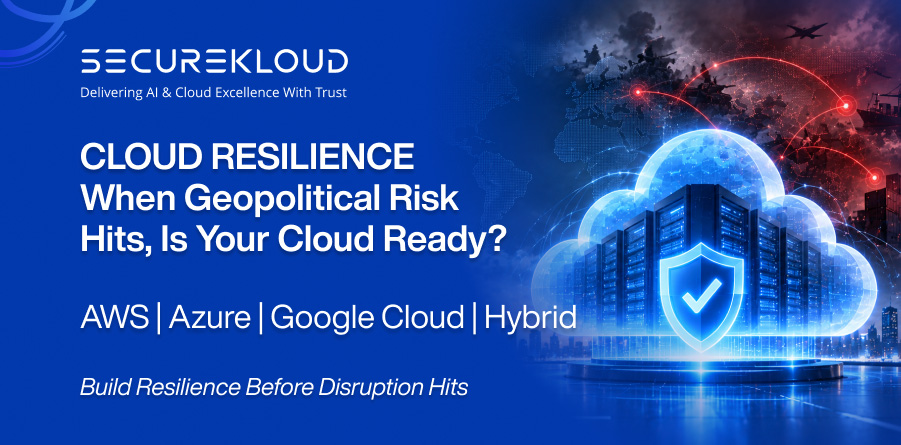
Modern enterprise technology is highly interconnected. Applications may run in one region while data is stored or replicated in another. Critical services may depend on cloud providers, SaaS platforms, network providers, security vendors, and other technology partners operating across different markets. This interconnected model gives enterprises flexibility and scale. But it can also create dependencies that become visible only when disruption occurs. Technology resilience can therefore no longer focus only on preventing infrastructure failure. Organizations also need to understand where technology dependencies sit, how concentrated they are, and how quickly the business can adapt when one becomes unavailable. That requires a broader approach to cloud resilience built around visibility, flexibility, recovery readiness, and continuous monitoring. 1. Know your cloud exposure You cannot build resilience around dependencies you cannot see. The first step is to map critical workloads, applications, data, cloud services, vendors, and supporting infrastructure across regions. The objective is not simply to create an inventory. Organizations need to understand how these components depend on one another and where multiple critical services rely on the same region, provider, or supporting system. A critical application may appear resilient because it runs in the cloud. But what happens if its data, authentication service, network connectivity, or another essential dependency is concentrated within the same failure domain? Identifying these relationships helps uncover concentration risks and single points of failure before they become business continuity problems. Key areas to assess include:- Critical workloads and their deployment regions
- Data storage and replication locations
- Cloud and SaaS dependencies
- Network and connectivity dependencies
- Third-party technology providers
- Single points of failure across critical services
- Workload resilience across regions
- Data replication and recovery requirements
- Recovery environments for critical applications
- Dependency and concentration risk
- Automated or orchestrated failover
- Recovery procedures across different cloud platforms
- Can the workload recover?
- Is the required data available?
- Can users reconnect?
- Can recovery happen within the organization’s required Recovery Point Objective (RPO) and Recovery Time Objective (RTO)?
A cloud resilience framework for managing disruption
These four priorities create a simple framework for assessing cloud resilience| Resilience Priority | Action | What to Strengthen |
|---|---|---|
| Know Your Cloud Exposure | Map critical dependencies | Identify workloads, data, cloud services and third-party dependencies across regions. Detect concentration risks and single points of failure. |
| Build Multi-Cloud Resilience | Design for flexibility and recovery | Strengthen workload and data resilience across regions. Establish tested DR and failover strategies for critical services. |
| Prepare for Disruption | Test before the crisis | Define RPO, RTO, escalation and recovery paths. Conduct regular DR simulations and validate recovery readiness. |
| Maintain Operational Visibility | Monitor continuously | Monitor infrastructure, security and availability 24×7. Use automation and anomaly detection to identify risks earlier. |
Where SecureKloud fits
Building resilience across complex cloud environments requires more than deploying additional infrastructure. SecureKloud helps enterprises manage cloud environments across AWS, Microsoft Azure, Google Cloud, hybrid, and on-premises infrastructure through Cloud Managed Services designed around operational visibility, security, recovery readiness, automation, and continuous optimization. Our capabilities span- 24×7 Cloud Operations
- Disaster Recovery as a Service (DRaaS)
- Cloud Security
- Multi-cloud management
- AI-powered monitoring, and automation
Six questions to assess your cloud resilience
Organizations do not need to wait for disruption to find the weak points in their cloud environment. A resilience assessment can start with six practical questions:- Do we know where our critical technology dependencies are concentrated?
- Can our most important workloads recover if a region becomes unavailable?
- Are critical data and supporting services included in our recovery strategy?
- Are our RPO and RTO targets defined and achievable?
- When did we last test failover and recovery?
- Do our teams have continuous visibility across cloud, applications, infrastructure, and security?
Wrap Up
Cloud resilience is an organization’s ability to keep critical cloud-based services available, adapt to disruption, and recover workloads and data when failures occur. It combines resilient architecture, disaster recovery, monitoring, security, operational processes, and recovery testing.
Geopolitical events can affect technology operations through regional restrictions, regulatory changes, connectivity disruption, vendor availability, data requirements, or other dependencies. The impact depends on where workloads, data, providers, and supporting services are located and how dependent they are on one another.
Cloud concentration risk occurs when critical workloads, data, applications, or supporting services depend heavily on the same cloud provider, region, technology, or third party. A disruption affecting that dependency can potentially affect multiple business services at the same time.
A multi-cloud strategy can provide additional deployment and recovery options across cloud platforms. However, using multiple clouds alone does not guarantee resilience. Workload dependencies, data availability, recovery architecture, failover procedures, RPO/RTO requirements, and testing still need to be addressed.
Disaster Recovery as a Service (DRaaS) helps organizations establish and operate recovery capabilities using secondary cloud environments. Depending on the implementation, it can support data replication, recovery infrastructure, automated failover and failback, monitoring, DR simulations, and recovery reporting.
Recovery Point Objective (RPO) defines the maximum acceptable amount of data loss measured in time. Recovery Time Objective (RTO) defines the target time within which a service should be restored following disruption.
The appropriate testing frequency depends on business criticality, regulatory requirements, architecture changes, and the organization’s risk profile. DR testing should also be considered after significant changes to critical workloads, infrastructure, dependencies, or recovery architecture.
AI and automation can support cloud operations through anomaly detection, alert correlation, automated remediation, predictive monitoring, and self-healing capabilities. These can help operations teams identify issues earlier and respond faster, while appropriate human oversight and operational controls remain important.