
- 7Minutes
- 1399Words
- 4Views
Cloud infrastructure gives enterprises the flexibility to scale applications, modernize operations and deploy AI workloads. However, variable consumption, fragmented billing and rising infrastructure demands make cloud spending increasingly difficult to predict and govern.
According to Flexera’s 2026 State of the Cloud Report, organizations estimate that 29% of their cloud spending is wasted. As AI adoption grows, enterprises must also account for compute-intensive workloads, unpredictable usage and the challenge of linking infrastructure costs to business outcomes.
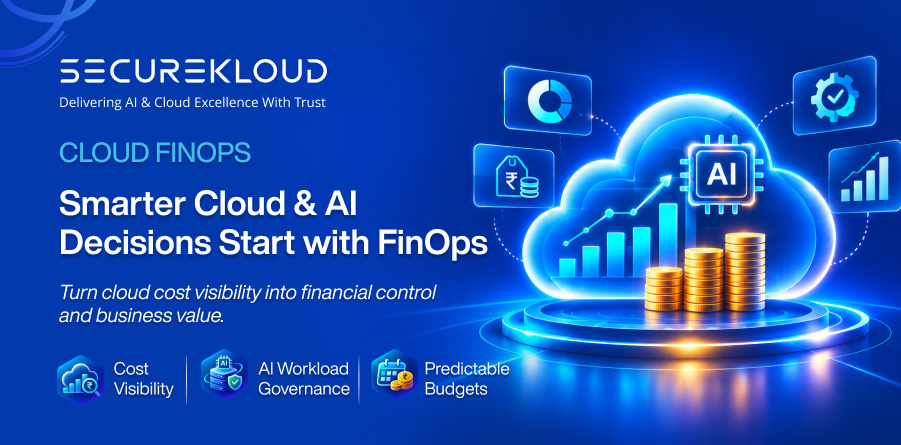
FinOps, the practice of cloud financial management, provides a structured approach to managing these challenges through cost visibility, continuous optimization and shared financial accountability.
In this blog, we will explore how FinOps helps enterprises improve cloud cost visibility, govern AI workloads, strengthen financial accountability and make informed cloud investment decisions.
Why Cloud and AI Costs Are Becoming Harder to Govern
Cloud spending becomes difficult to control when consumption grows faster than financial oversight. Even organizations with cost dashboards may struggle to identify the teams, applications and workloads responsible for spending.
Several challenges contribute to this complexity.
- Limited cost visibility: Multi-cloud and hybrid environments generate billing data across providers, accounts and services. Without consistent tagging and cost allocation, finance and IT teams cannot reliably attribute spending to individual workloads or business units.
- Underutilized resources: Idle instances, oversized virtual machines, unused storage and poorly managed commitments increase expenditure without delivering corresponding business value.
- Fragmented accountability: Engineering teams manage infrastructure; procurement negotiates contracts and finance controls budgets. When these functions operate independently, spending decisions lack a shared financial context.
- Unpredictable AI workloads: Model training, inference, GPU consumption and experimentation introduce new cost variables. Usage can fluctuate significantly between development, testing and production.
For government agencies, these challenges become particularly significant because annual appropriations, procurement approvals and public accountability requirements leave limited room for unexpected expenditure.
How FinOps Enables Smarter Cloud and AI Decisions
FinOps connects financial data with operational decisions. It gives engineering, finance and business teams a common understanding of cloud consumption, cost drivers and the value delivered by technology investments.
Five capabilities make this possible.
Effective FinOps begins with understanding where cloud spending originates. Consistent tagging, workload-level reporting and cost allocation help enterprises identify which applications, departments and environments consume resources. Showback provides business units with visibility into their consumption, while chargeback assigns costs to the teams responsible for them. This accountability supports more accurate budgeting and helps leaders evaluate spending against operational priorities.
Cloud optimization requires regular evaluation of resource utilization, performance and cost. FinOps helps teams identify idle resources, rightsize workloads, review storage consumption and evaluate pricing commitments.
For example, a virtual machine showing consistently low utilization may appear suitable for downsizing. However, engineering teams must first determine whether it supports disaster recovery, periodic processing or other critical workloads. Effective optimization considers workload requirements before implementing changes.
3. AI-Driven Forecasting and Budget Planning
Traditional budget estimates often rely heavily on historical spending. AI-driven forecasting can incorporate consumption trends, workload behavior and seasonal demand to support more informed projections. FinOps teams can use these insights to anticipate spending changes, identify potential budget overruns and evaluate the financial implications of scaling infrastructure. For public sector organizations, improved forecasting also supports budget submissions and expenditure justification within fixed funding cycles.
Unexpected spending can result from configuration errors, unplanned resource deployment or sudden workload increases. Automated anomaly detection helps teams identify unusual consumption patterns and investigate their causes before costs escalate. Budget thresholds, alerts and approval policies add another layer of financial control. Together, these practices make cloud spending easier to monitor and govern.
Cost reduction alone does not establish whether a cloud investment is successful. Enterprises also need to assess application performance, availability, operational efficiency and business outcomes. FinOps enables teams to examine unit economics, such as infrastructure cost per transaction, application workload or AI inference request. These measures help decision makers evaluate whether increased spending produces proportionate business value.
Why Do AI Workloads Need FinOps?
AI introduces financial management challenges that differ from conventional application hosting. Training and inference workloads may require specialized compute resources, while API-based AI services often use consumption-based pricing. Development teams may also run multiple experiments before selecting a production model. Without cost attribution, enterprises can struggle to determine how much each AI initiative consumes and whether that investment supports measurable outcomes. This is where FinOps for AI becomes essential.
The FinOps Foundation’s 2026 State of FinOps survey found that 98% of respondents were managing AI spending, compared with 63% in 2025. This reflects the growing importance of financial oversight as AI becomes part of enterprise infrastructure. Applying FinOps to AI involves tracking compute utilization, inference costs, storage, data movement and workload-level consumption. Teams can then compare deployment options, establish budgets and evaluate performance against cost.
For example, an enterprise deploying a document-processing AI application may monitor infrastructure spending alongside documents processed, processing time and service reliability. This provides a more useful basis for investment decisions than infrastructure spending alone.
Building a Continuous FinOps Operating Model
A mature FinOps practice requires more than a reporting platform. It depends on coordinated decisions across engineering, finance, procurement and business teams. Enterprises can establish continuous financial governance through four practices:
- Standardize cost allocation: Apply consistent tagging, ownership rules and reporting structures across cloud environments.
- Establish shared accountability: Define responsibilities for budgeting, optimization, approvals and expenditure reviews.
- Automate monitoring and recommendations: Use continuous reporting, anomaly detection and optimization insights to reduce reliance on periodic manual audits.
- Measure realized outcomes: Track actual savings, forecast accuracy, workload performance and cost allocation improvements.
Automation can also support self-healing operations by detecting infrastructure issues and initiating approved remediation actions. Such capabilities should operate within defined policies, security controls and workload performance requirements. The operating model must support continuous improvement as cloud consumption and business priorities change.
How SecureKloud Supports Continuous FinOps
SecureKloud Technologies helps enterprises establish continuous cost visibility, optimization and governance across cloud environments.
Our FinOps capabilities focus on four areas:
- Visibility: Monitor cloud consumption, spending patterns and cost allocation across environments.
- Optimization: Support continuous resource optimization and autonomous self-healing to improve operational efficiency.
- Governance: Strengthen budget controls, financial accountability and chargeback practices across business units.
- Insights: Apply AI-driven forecasting and consumption analysis to support financial planning and informed decisions.
By combining these capabilities with cloud operations, SecureKloud helps organizations improve financial oversight while supporting workload performance and business priorities.
Wrap up
Cloud and AI investments require financial governance that keeps pace with changing consumption. FinOps helps enterprises move from periodic cost reviews to continuous visibility, optimization and accountability. It also enables finance, engineering and business teams to evaluate cloud spending in relation to performance and measurable value.
For enterprises and public sector organizations, this approach supports more predictable budgets, responsible AI adoption and better-informed technology investments.
Explore SecureKloud’s FinOps capabilities to strengthen cloud cost visibility, optimization and governance across your enterprise.
FinOps improves cloud cost management through continuous spending visibility, resource optimization, cost allocation, forecasting and shared accountability between engineering, finance and business teams.
Financial intelligence evaluates potential savings alongside workload economics, cloud spending commitments and business outcomes. It also helps organizations verify whether optimization changes produce measurable financial benefits.
FinOps provides cost attribution, forecasting, budget controls and auditable spending data. These capabilities help public sector organizations manage variable cloud consumption within approved funding and procurement requirements.
Yes. FinOps platforms can support automated monitoring, anomaly detection, rightsizing recommendations and policy-based optimization. Autonomous changes require appropriate operational safeguards and governance.