
- 5Minutes
- 803Words
- 37Views
What is AI-Driven Cloud Orchestration?
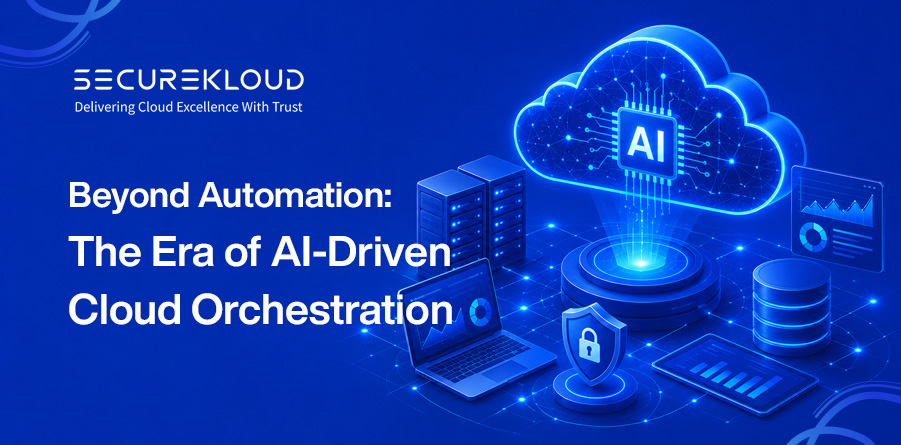
AI-driven cloud orchestration is the automated coordination, management, and optimization of complex multi-cloud and hybrid cloud environments using machine learning and advanced analytics. Unlike traditional template-based orchestration, AI-driven engines dynamically adapt infrastructure workflows in real-time based on shifting workload requirements, cost metrics, and security anomalies. By embedding continuous machine intelligence into your underlying Cloud Automation & Data Platform (CADP), enterprises transition away from rigid, reactive script maintenance toward a flexible, self-optimizing technical ecosystem.Core Components of Intelligent Cloud Orchestration
Implementing an advanced orchestration model involves three foundational pillars:- Predictive Workload Scaling: Instead of waiting for a CPU threshold breach to trigger a reactive scaling event, machine learning algorithms analyze historical traffic patterns to accurately forecast usage surges, scaling up environments before performance degradation occurs.
- Dynamic Resource Allocation: Workloads are shifted continuously between compute nodes based on immediate cost and processing efficiency, allowing teams to unlock advanced efficiency without manual engineering intervention.
- Autonomous Security Remediation: By integrating automated threat logic directly into runtime orchestration, the infrastructure can instantly isolate compromised nodes or patch vulnerabilities autonomously.
Why Enterprises are Moving from Static Automation to AI Orchestration
Traditional IT Operations (ITOps) tools are hitting a breaking point under the weight of containerized applications, microservices, and hybrid cloud architectures.| Feature / Model | Static Automation | AI-Driven Orchestration |
|---|---|---|
| Logic Engine | Rules-Based | Context-Aware |
| Operational Scope | Siloed Tasks | End-to-End Workflows |
| Resolution Model | Human Intervention Needed | Autonomous Resolution |
Key Business Benefits of Intelligent Infrastructure Management
1. Maximizing Cloud Financial Efficiency Unmanaged multi-cloud environments frequently suffer from sticker shock due to over-provisioned instances and abandoned storage blocks. Integrating predictive orchestration ensures that your overarching cloud cost optimization targets are met automatically by right-sizing resources in real-time, shutting down non-essential dev environments, and utilizing spot instances safely. 2. Driving High-Availability Through Self-Healing Systems System reliability is significantly enhanced when orchestration layers can identify micro-anomalies before they escalate into full-scale outages. Leveraging a self-healing infrastructure allows the orchestration platform to automatically reroute traffic, spin up redundant microservices, and clear application bottlenecks without requiring midnight emergency calls to your engineering teams. 3. Unifying Complex Hybrid Configurations Most mature enterprises do not rely on a single public cloud provider; instead, they operate across complex on-premises data centers and multiple hyperscalers. A robust, intelligent hybrid cloud strategy relies on AI orchestration to treat these fragmented architectures as a single, cohesive pool of compute and storage.The Strategic Value of Enterprise Managed Services
Building, maintaining, and continuously tuning an internal AI-driven orchestration engine requires massive, specialized talent and significant capital investment. For forward-thinking organizations, partnering with elite Cloud Managed Services providers bridge this resource gap immediately. A certified managed services provider delivers production-ready AI frameworks, continuous compliance auditing, and proactive cost optimization right out of the box, freeing internal engineering squads to focus purely on core product innovation rather than routine infrastructure maintenance.Wrap Up
AI-driven cloud orchestration combines automation with artificial intelligence to coordinate cloud infrastructure, applications, and operational workflows while making context-aware decisions based on real-time data.
Standard automation executes explicit, rules-based tasks sequentially (e.g., if X happens, do Y). AI orchestration understands the global context of the entire application ecosystem, making autonomous, data-driven decisions when unpredictable variables arise.
Yes. By continuously monitoring data footprints and utilization trends, the platform automatically downscales idle assets, cleans up orphan resources, and optimizes spending without degrading application performance.
AI enhances cloud operations by predicting infrastructure demand, automating incident remediation, optimizing cloud costs, enforcing governance policies, and improving operational decision-making.
Yes. AI-driven orchestration platforms help organizations manage workloads, optimize resources, enforce governance, and automate operations across hybrid and multi-cloud infrastructures.