
- 9Minutes
- 1656Words
- 39Views
Businesses are operating across hybrid infrastructure, multi-cloud ecosystems, cloud-native applications, distributed workloads, containers, Kubernetes environments, and rapidly evolving DevOps pipelines.
As cloud adoption accelerates, operational complexity continues to grow alongside it. For many organizations, managing cloud operations manually is becoming increasingly difficult. Operations teams are often overwhelmed by large volumes of alerts, fragmented monitoring tools, rising cloud costs, inconsistent governance controls, and limited real-time visibility across environments.
What was once manageable through traditional monitoring and manual intervention is now creating operational bottlenecks at scale.
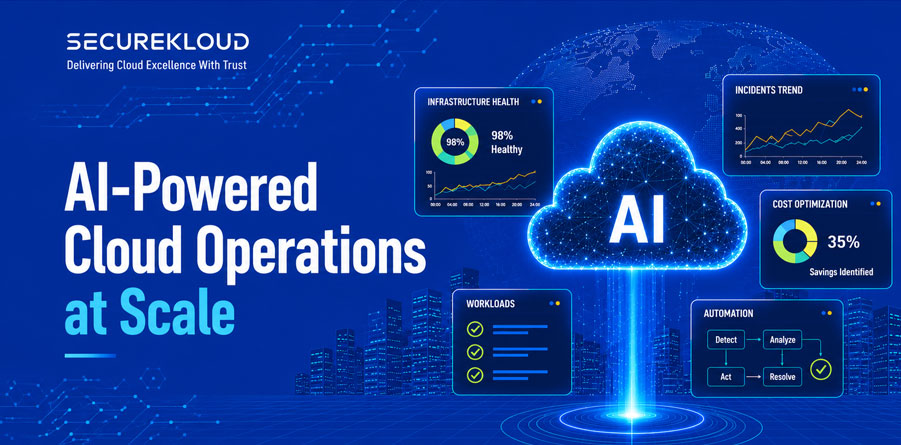
This is where AI-powered Cloud Operations, commonly known as AIOps, is emerging as a critical operational layer for businesses. AIOps helps organizations move from reactive cloud management toward intelligent, automated, and predictive cloud operations.
Instead of simply monitoring infrastructure, businesses are now using AI to identify anomalies, automate responses, improve operational visibility, optimize cloud resources, and strengthen governance across complex cloud ecosystems.
As cloud environments continue expanding, AI-powered operations are becoming essential for scalability, operational efficiency, and long-term business resilience.
Cloud Operations Are Becoming Too Complex
Cloud environments no longer operate within a single infrastructure model. Organizations today manage workloads across:
- public cloud platforms
- private cloud environments
- hybrid infrastructure
- multi-cloud ecosystems
- edge environments
- cloud-native applications
At the same time, businesses are expected to maintain:
- high availability
- operational visibility
- governance consistency
- cybersecurity readiness
- performance optimization
- cost efficiency
In many environments, operations teams still rely heavily on manual monitoring, disconnected tools, and reactive incident management approaches. As infrastructure scales, this often leads to alert fatigue, delayed issue resolution, inconsistent operational visibility, rising cloud costs, operational inefficiencies, and governance gaps across cloud environments.
Cloud operations are no longer just an infrastructure management function. They are now directly tied to business continuity, operational agility, customer experience, and scalability.
Why Traditional Cloud Monitoring Does Not Suffice
Traditional monitoring tools were designed for simpler infrastructure environments. Modern cloud ecosystems generate massive volumes of operational data across applications, infrastructure, workloads, networks, APIs, containers, and user environments.
Teams alone cannot efficiently process this scale of operational information in real time. This is one of the biggest reasons buisnesses are moving toward AI-powered cloud operations.
Traditional cloud monitoring often creates challenges such as:
- excessive alerts without operational context
- fragmented visibility across tools
- reactive troubleshooting
- slower incident response
- limited predictive capabilities
- manual operational dependency
In large cloud environments, operations teams may spend significant time identifying root causes instead of resolving issues quickly.
As businesses scale their cloud footprint, operational intelligence becomes increasingly important. Organizations now require systems that can:
- identify patterns automatically
- predict operational risks
- correlate events across environments
- prioritize critical incidents
- automate operational responses
This shift is driving the rise of AIOps platforms across businesses cloud ecosystems.
What is AIOps?
AIOps, or AI-Powered IT Operations, refers to the use of artificial intelligence, machine learning, analytics, and automation to improve cloud and IT operations management.
Instead of relying solely on manual monitoring and reactive operations, AIOps platforms continuously analyze operational data across cloud environments to identify anomalies, predict issues, automate workflows, and improve operational decision-making.
AIOps platforms help businesses:
- monitor cloud environments intelligently
- detect abnormal system behavior
- automate incident response
- improve operational visibility
- optimize infrastructure usage
- strengthen governance and operational control
The goal is not to replace operations teams, but to help business operate increasingly complex cloud environments more efficiently and intelligently at scale.
How AI-Powered Cloud Operations Improve Execution
Infrastructure operations are increasingly moving toward automation-led management.
Organizations are adopting:
- AI-driven monitoring
- automated incident response
- Infrastructure as Code (IaC)
- predictive analytics
- automated scaling and patch management
These capabilities help enterprises improve operational consistency while reducing manual intervention.
Why Organizations Are Moving Toward Managed Infrastructure Services
Modern infrastructure management is no longer just about maintaining servers and networks.
Organizations today are looking for:
- operational scalability
- cloud governance
- cybersecurity readiness
- business continuity
- infrastructure visibility
- predictable operational performance
Managed infrastructure services help enterprises build resilient IT environments while reducing operational overhead.
How SecureKloud Supports Enterprise Infrastructure Operations
Predictive Monitoring
AIOps platforms help businesses recognize operational behavior patterns across cloud environments, enabling teams to identify potential performance issues and infrastructure risks before they impact business operations. This helps businesses move from reactive operations toward predictive operational management.
Anomaly Detection
AIOps systems continuously monitor cloud environments to detect unusual behavior, abnormal traffic patterns, infrastructure inconsistencies, or unexpected workload activity. This improves operational visibility and helps teams identify issues earlier.
Automated Remediation
Modern AIOps platforms can automate routine operational tasks such as restarting workloads, reallocating resources, resolving configuration issues, and scaling infrastructure dynamically. This helps businesses reduce manual intervention, accelerate incident resolution, and maintain operational continuity across cloud environments. This reduces manual operational dependency and accelerates issue resolution.
Intelligent Cloud Cost Optimization
AI-driven operational intelligence helps organizations identify underutilized resources, idle infrastructure, inefficient workload allocation, and unnecessary cloud spending across environments. This improves cloud cost governance while maintaining operational performance.
Governance Visibility
As businesses expand across multiple cloud environments, governance becomes increasingly difficult to manage manually. AIOps platforms help improve visibility into policy compliance, infrastructure usage, operational risks, configuration consistency, and cloud governance controls.
Operational Intelligence
AI-powered cloud operations platforms provide deeper operational insights across business environments. This allows teams to make faster and more informed operational decisions using real-time intelligence instead of manual analysis alone.
Why AIOps Matters in Hybrid & Multi-Cloud Environments
As hybrid and multi-cloud adoption continues growing, intelligent cloud operations are becoming increasingly important for business scalability and operational resilience.
Business Benefits of AIOps
Improved Operational Efficiency
AI-powered automation reduces repetitive operational tasks and allows teams to focus more on strategic initiatives and critical decision-making.
Reduced Downtime
Predictive monitoring and intelligent anomaly detection help organizations identify and resolve issues faster before they impact business operations.
Faster Incident Response
Automated operational workflows improve response times and reduce delays caused by manual troubleshooting.
Better Scalability
AIOps enables businesses to scale cloud environments more efficiently without proportionally increasing operational overhead.
Stronger Governance
Improved visibility and automated policy monitoring help organizations maintain governance consistency across cloud ecosystems.
Lower Operational Overhead
Automation-driven cloud operations reduce manual operational dependency and improve long-term infrastructure management efficiency.
Why AIOps is Becoming a Strategic Business Requirement
A few years ago, AIOps was largely viewed as an innovation initiative. Today, it is rapidly becoming an operational necessity. Cloud environments are expanding faster than traditional operational models can manage efficiently.
Organizations are expected to deliver:
- always-on digital experiences
- scalable infrastructure
- faster operational response
- stronger governance
- optimized cloud spending
- real-time operational visibility
At the same time, operational complexity continues increasing across hybrid infrastructure, multi-cloud deployments, cloud-native applications, and distributed workloads.
Manual operations alone are no longer sustainable at scale. As a result, businesses are increasingly adopting AI-powered cloud operations as a long-term operational strategy rather than a standalone technology initiative.
AIOps is becoming foundational to how businesses manage scalability, operational resilience, governance, and cloud execution in modern digital ecosystems.
How SecureKloud Enables AI-Powered Cloud Operations Through CaDP
SecureKloud’s Cloud Automation and Data Platform (CaDP) helps businesses simplify and modernize cloud operations through automation, operational visibility, governance-driven execution, and intelligent cloud management capabilities.
CaDP is designed to help organizations improve operational efficiency across complex cloud ecosystems by enabling:
- cloud automation
- governance-driven operations
- infrastructure visibility
- operational intelligence
- data-driven decision-making
- scalable cloud execution
By combining cloud automation with operational intelligence, businesses can reduce manual operational dependency while improving agility, scalability, and governance consistency across cloud environments.
As organizations continue accelerating cloud adoption, platforms such as CaDP help businesses move toward more intelligent, scalable, and operationally efficient cloud ecosystems.
Wrap Up
Organizations that embrace intelligent cloud operations early will be better positioned to manage complexity, accelerate innovation, and build future-ready cloud ecosystems.
AIOps improves cloud operations by helping businesses automate monitoring, identify anomalies, predict infrastructure issues, improve operational visibility, and reduce manual operational dependency across cloud environments.
AI-powered cloud management helps enterprises use artificial intelligence and automation to monitor, optimize, govern, and manage complex hybrid and multi-cloud environments more efficiently.
AIOps helps businesses improve operational visibility, strengthen governance, reduce downtime, automate incident response, and manage hybrid cloud environments more efficiently at scale.
Cloud operations automation using AI helps businesses automate repetitive operational tasks, improve infrastructure monitoring, accelerate issue resolution, and optimize cloud resource management across environments.
Predictive analytics in cloud operations uses AI and operational data patterns to identify potential infrastructure risks, performance issues, and operational anomalies before they impact business operations.
AI-powered cloud governance and monitoring help businesses maintain operational visibility, improve policy compliance, optimize cloud usage, and strengthen governance consistency across cloud ecosystems.
Intelligent cloud infrastructure management uses AI-driven operational intelligence and automation to manage cloud infrastructure more efficiently across hybrid and multi-cloud environments.
AI-driven operational visibility helps businesses monitor distributed cloud environments in real time, identify operational risks earlier, improve governance oversight, and make faster operational decisions.