
- 5Minutes
- 947Words
- 41Views
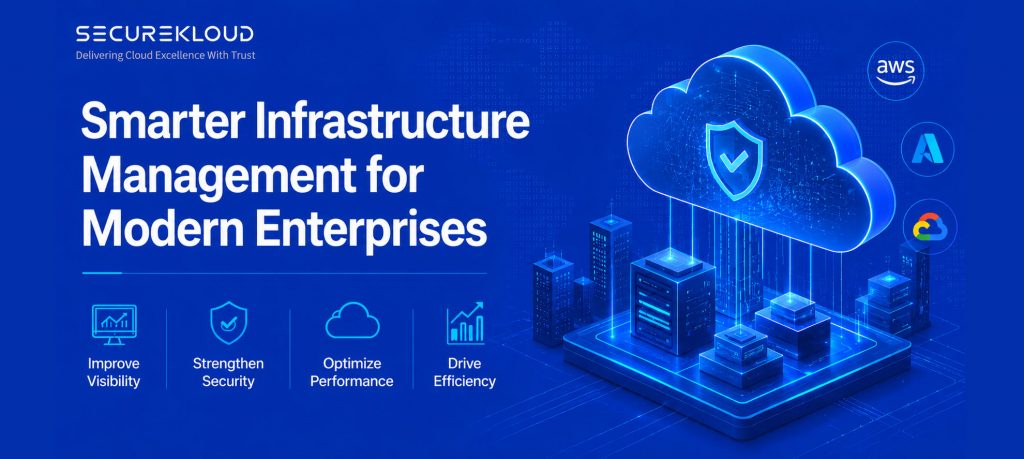
Modern enterprises depend on IT infrastructure for every critical business function, from customer operations and internal collaboration to cloud applications, cybersecurity, and data management.
As organizations scale, managing infrastructure across cloud, hybrid, and on-premises environments becomes increasingly complex. Downtime, security gaps, rising cloud costs, and operational inefficiencies can directly impact business continuity and growth.
This is where IT Infrastructure Management Services (IMS) play a critical role.
At SecureKloud Technologies, we help organizations simplify infrastructure operations through Cloud Managed Services, improve visibility, strengthen security, and build scalable cloud environments across AWS, Azure, and GCP ecosystems.
What are IT Infrastructure Management Services?
IT Infrastructure Management Services refer to the monitoring, administration, optimization, and support of enterprise IT environments.
This includes:
- Cloud infrastructure management
- Server and storage management
- Network monitoring and optimization
- Security and compliance management
- Backup and disaster recovery
- End-user and remote support
- Hybrid and multi-cloud operations
- Performance monitoring and incident management
The goal is simple:
Ensure infrastructure remains secure, available, scalable, and operationally efficient.
Why Enterprises Are Struggling with Infrastructure Complexity
As digital transformation accelerates, many organizations are facing new infrastructure challenges:
Increasing Cloud Complexity
Managing workloads across hybrid and multi-cloud environments often leads to visibility gaps, inconsistent governance, and operational inefficiencies.
Rising Infrastructure Costs
Without continuous monitoring and optimization, cloud environments can quickly become expensive and difficult to control.
Operational Downtime
Infrastructure outages, performance bottlenecks, and delayed incident resolution directly impact productivity and customer experience.
Security and Compliance Risks
Cyber threats continue to evolve, while compliance requirements become more demanding across industries.
Limited Internal IT Bandwidth
Many internal IT teams spend significant time on infrastructure maintenance instead of focusing on innovation and transformation initiatives.
How IT Infrastructure Management Services Improve Efficiency
Proactive Monitoring and Faster Issue Resolution
Modern infrastructure environments require continuous monitoring.
Managed infrastructure services help organizations identify performance issues, outages, and risks before they impact operations.
With proactive monitoring and 24×7 support, enterprises can:
- reduce downtime
- improve system availability
- accelerate incident resolution
- maintain operational continuity
Better Cloud Cost Optimization
Cloud adoption without governance often results in resource sprawl and unnecessary spending.
Infrastructure management services help organizations:
- optimize cloud utilization
- eliminate idle resources
- improve workload efficiency
- strengthen FinOps visibility
This enables enterprises to maintain performance while improving cost control.
Improved Security and Governance
Security can no longer operate separately from infrastructure management.
Managed infrastructure services help organizations strengthen:
- endpoint protection
- network security
- access governance
- backup and recovery readiness
- compliance monitoring
This reduces operational risk while improving overall infrastructure resilience.
Hybrid and Multi-Cloud Simplification
Many enterprises now operate across:
- on-premises infrastructure
- private cloud
- AWS
- Azure
- GCP
Managing these environments internally can become operationally intensive.
Infrastructure management services simplify hybrid cloud operations by providing centralized visibility, monitoring, automation, and governance across environments.
Organizations are also increasingly investing in cloud migration strategies to simplify hybrid operations and improve scalability.
Improved Workforce Productivity
Infrastructure issues often slow internal teams and business operations.
By improving infrastructure stability and support responsiveness, organizations can:
- reduce user disruptions
- improve application performance
- minimize support delays
- improve employee productivity
This allows internal teams to focus more on strategic business initiatives.
Why Automation Matters in Infrastructure Management
Infrastructure operations are increasingly moving toward automation-led management.
Organizations are adopting:
- AI-driven monitoring
- automated incident response
- Infrastructure as Code (IaC)
- predictive analytics
- automated scaling and patch management
These capabilities help enterprises improve operational consistency while reducing manual intervention.
Why Organizations Are Moving Toward Managed Infrastructure Services
Modern infrastructure management is no longer just about maintaining servers and networks.
Organizations today are looking for:
- operational scalability
- cloud governance
- cybersecurity readiness
- business continuity
- infrastructure visibility
- predictable operational performance
Managed infrastructure services help enterprises build resilient IT environments while reducing operational overhead.
How SecureKloud Supports Enterprise Infrastructure Operations
SecureKloud Technologies helps organizations modernize and manage infrastructure environments through:
- Cloud Managed Services
- Hybrid Cloud Operations
- FinOps and Cost Governance
- DevOps and Infrastructure Automation
- Disaster Recovery as a Service (DRaaS)
- 24×7 Infrastructure Monitoring and Support
- AWS, Azure, and GCP expertise
With deep experience across enterprise cloud ecosystems, SecureKloud enables organizations to improve operational efficiency, infrastructure reliability, and long-term scalability.
Wrap Up
By combining cloud expertise, operational governance, automation, and proactive support, organizations can transform infrastructure from an operational challenge into a strategic business enabler.
Looking to improve cloud visibility, infrastructure efficiency, and operational scalability?
Connect with SecureKloud Technologies to explore our Cloud Managed Services capabilities.
IT infrastructure management services improve operational efficiency by reducing downtime, improving system visibility, optimizing cloud resources, automating monitoring, and strengthening infrastructure performance across enterprise environments.
Managed infrastructure services help organizations improve scalability, strengthen security, reduce operational overhead, optimize cloud costs, and maintain infrastructure reliability through proactive monitoring and support.
Cloud infrastructure management involves monitoring, optimizing, securing, and managing enterprise cloud environments across AWS, Azure, GCP, hybrid cloud, and multi-cloud ecosystems.
Hybrid cloud infrastructure management services help organizations simplify operations across on-premises and cloud environments while improving governance, visibility, scalability, and operational consistency.
Organizations can reduce IT infrastructure downtime through proactive monitoring, automated incident response, backup and disaster recovery planning, infrastructure optimization, and 24×7 support services.
Infrastructure monitoring and support services help organizations continuously track infrastructure performance, identify risks early, resolve incidents faster, and maintain business continuity.
Cloud governance helps organizations maintain security, compliance, cost control, operational consistency, and resource visibility across cloud and hybrid environments.
Managed services for hybrid cloud operations help enterprises manage workloads across on-premises systems, private cloud, and public cloud environments through centralized monitoring, automation, and operational governance.