
- 8Minutes
- 1709Words
- 4Views
AI is becoming part of how enterprises monitor infrastructure, analyse incidents and manage cloud environments. It can identify unusual activity, suggest corrective actions and help operations teams respond to changing conditions. However, identifying a possible solution is different from having the authority to implement it.
Consider an AI system recommending additional computing resources to address application latency. The recommendation may improve performance, but it could also increase cloud spending. Similarly, changing a network configuration might restore connectivity while creating an unexpected security exposure.
“Who determines whether an AI-recommended action is safe, necessary and authorised?”
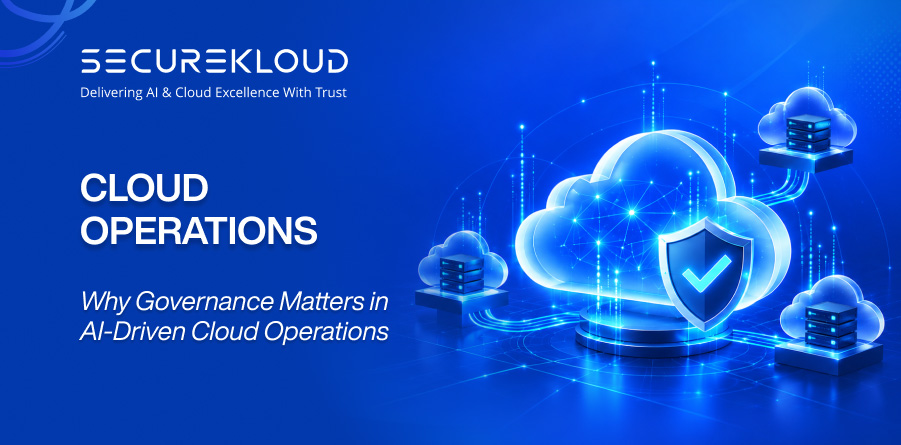
This is where governance becomes essential to AI-driven cloud operations.
In this blog, we will explore why AI-assisted cloud management requires defined operational controls, how enterprises can establish boundaries for automation and what governance means for secure, accountable cloud operations.
Why AI-Driven Cloud Operations Need Governance
Cloud operations teams make decisions that directly affect application availability, infrastructure performance, security and cost. As Enterprise AI becomes part of these workflows, it can support engineers by analysing operational information and suggesting actions. However, a recommendation based on technical evidence may not account for every business requirement or operational restriction.
For example, increasing infrastructure capacity could address a performance problem but exceed an approved spending limit. Restarting an application might clear an error while interrupting an important business process. A technically possible action is not always an operationally acceptable one.
Governance provides the rules and decision processes that determine how recommendations are reviewed, approved and executed. Without these controls, organisations risk introducing automation that operates beyond established security policies, change management procedures or financial boundaries. The point is not to restrict the use of AI; however, it is to ensure that AI-assisted operations remain consistent with enterprise requirements.
AI Recommendations and Automated Execution Aren’t the Same
One of the most important distinctions in AI-driven cloud operations is the difference between recommending an action and executing it. An AI system may identify an unusual increase in resource consumption and suggest scaling an application. That recommendation can be useful even when the system has no permission to change the infrastructure. Execution introduces another level of responsibility. Before a change takes place, the organisation must consider whether the action is permitted, which systems it affects and what safeguards are required.
A practical governance model separates three responsibilities:
• AI-assisted analysis
AI examines relevant operational information and identifies possible responses. Its recommendations provide decision support rather than automatic authorisation.
• Operational approval
The appropriate person or policy determines whether the recommended action can proceed. The approval process should reflect the potential impact of the change.
• Controlled execution
Once authorised, the action is performed through an approved workflow. The result is then checked against the intended outcome.
This separation allows enterprises to benefit from AI-assisted insights without giving every recommendation unrestricted access to production systems.
Defining Automation Boundaries in Cloud Operations
Routine operational tasks
Activities such as collecting diagnostic information, generating incident summaries or checking resource utilisation may be suitable for automation when appropriate access controls are in place. These tasks primarily support operational visibility and do not necessarily change the running environment.
Certain recurring incidents may have established remediation procedures. For example, an organisation might permit a predefined recovery action for a non-critical workload when specific conditions are met. Such automation should operate within documented limits and include checks to confirm whether the action succeeded.
High-impact infrastructure changes
Changes involving production deployments, access permissions, network configurations or critical workloads require greater scrutiny. Even when AI identifies a plausible solution, the potential consequences may justify additional review. The automation boundary should therefore reflect the risk associated with the action, rather than the confidence of an AI recommendation alone.
Building Governance into AI-Assisted Cloud Workflows
AI-assisted tools and automation workflows should have access only to the systems and actions necessary for their approved functions. Permissions must reflect operational responsibilities and the sensitivity of the environment. A system used to analyse incidents, for example, does not automatically require permission to modify production infrastructure.
Organisations should define the conditions under which an automated action is allowed. These conditions may include the affected environment, type of incident, permitted change, resource limits and required safeguards. A predefined policy helps prevent an automation workflow from expanding beyond its intended purpose.
3. Approval and Escalation Workflows
Some actions require explicit authorisation. Approval requirements should be determined by the nature and potential impact of the change. When a recommendation falls outside an approved automation policy, the workflow should route it to the appropriate engineer or authorised reviewer.
4. Audit Trails and Decision Records
Enterprises need visibility into how operational actions were selected and executed. Relevant records may include the incident context, AI-generated recommendation, supporting evidence, approval decision, action taken and resulting system behaviour. These records support incident reviews, internal accountability and compliance processes.
An approved action is not necessarily a successful action. After execution, the team must confirm whether the intended result was achieved and whether the change affected other services. Where appropriate, operational procedures should include rollback options and escalation steps if the action fails. Together, these controls establish a more accountable approach to AI-assisted cloud management.
What Strong AI Governance Means for Enterprise Cloud Teams
When governance is integrated into AI-driven cloud operations, enterprises can establish clearer expectations for how decisions are made and implemented.
- Greater operational accountability: Defined roles and approval procedures make it easier to determine who is responsible for authorising and executing changes.
- More consistent automation: Documented policies help teams apply approved procedures across similar operational situations.
- Better protection for production environments: Access restrictions, change controls and validation procedures reduce the likelihood of unauthorised or unsuitable actions.
- Improved cost oversight: Resource limits and financial approval requirements help organisations assess the spending implications of operational recommendations.
- Stronger audit readiness: Maintaining records of recommendations, decisions and actions supports internal reviews and compliance-related requirements.
These outcomes depend on effective policy design, implementation and ongoing review. Governance cannot eliminate operational risk, but it can make that risk easier to identify, manage and investigate.
How SecureKloud Provides Cloud Security and Governance
Enterprises adopting AI-driven cloud operations need a dependable foundation for infrastructure management, security oversight, operational automation and cost control.
SecureKloud Technologies supports these requirements through its Cloud Managed Services, helping organisations manage cloud environments with structured operational processes.
Our capabilities include:
- Cloud Security and Governance: Supporting security monitoring, access controls and governance practices across cloud environments.
- Hybrid and Multi-Cloud Management: Managing operational requirements across distributed cloud infrastructure.
- AI-Driven Cloud Optimization and Automation: Supporting cloud resource management and operational efficiency through automation and data-driven insights.
- FinOps and Cost Optimization: Infrastructure management, backup and recovery support for business-critical workloads.
- 24×7 Cloud Operations Support: Providing continuous monitoring and operational support for cloud infrastructure.
These capabilities contribute to the operational foundation required for secure and accountable cloud management.
The governance practices described in this article represent considerations for enterprises adopting AI-assisted operations. Their implementation depends on the organisation’s existing policies, technology environment and available integrations.
Wrap up
Enterprise AI can help cloud teams identify issues, evaluate options and recommend operational actions. However, the ability to recommend a change does not remove the need to determine whether that change is appropriate.
Governance connects AI-assisted insights with the policies, permissions and approval processes that guide enterprise cloud operations. By defining automation boundaries, managing operational trade-offs and validating outcomes, organisations can introduce AI into cloud workflows while retaining control over critical systems.
The value of AI-driven cloud operations depends not only on what AI can recommend, but also on how responsibly those recommendations are put into action.
To strengthen cloud security, operational governance and cost visibility, talk to our cloud experts.
Governance in AI-driven cloud operations refers to the policies, permissions, approval procedures and monitoring controls that determine how AI-assisted recommendations and automated actions are managed within cloud environments.
Human oversight helps ensure that sensitive or high-impact operational decisions are reviewed against business priorities, security requirements and change management policies before execution.
Certain operational activities can be automated when they follow approved procedures and have appropriate safeguards. High-impact changes may require additional authorisation, validation and recovery controls.
Governance can establish resource limits, spending policies and approval requirements for infrastructure changes. These controls help teams assess the financial implications of AI-recommended actions.
AI recommendations provide possible actions based on available operational information. Automated execution performs an action through a defined workflow. Governance determines whether the action is permitted and which approvals or safeguards are necessary.
SecureKloud’s Cloud Managed Services support cloud security, infrastructure management, operational monitoring, automation and cost optimisation. These capabilities help enterprises establish a foundation for more controlled cloud operations.